Tomorrow’s agriculture is being built today, and the North Carolina State University CEA Coalition is leading the charge.
This isn’t a think tank. It’s a powerhouse of researchers, engineers, and industry leaders, all working together to solve the toughest challenges in controlled environment agriculture (CEA)—and doing it at the speed of the market, not academia.
What sets them apart? A completely different research model.
Instead of crawling through the pipeline of traditional research, where findings take years to reach commercial growers, the coalition flips the process:
✅ Industry sets the agenda—real challenges, real priorities.
✅ Multi-disciplinary teams break out of silos and collaborate.
✅ Rapid experimentation & deployment—from lab to greenhouse fast.
And it’s working.
Breaking Down Silos to Speed Up Innovation
Here’s the reality: Academia moves slowly. The market doesn’t have that luxury.
Ideas that look promising in a lab can take five to ten years to reach commercial farms—if they ever do.
Ricardo Hernandez, associate professor of horticulture science and one of the coalition’s founders, saw this problem firsthand.
💬 “You start doing research, and soon realize we need to create a greater impact.”
He had two key realizations:
1️⃣ The traditional research pipeline is too slow—by the time discoveries reach growers, they’re often outdated.
2️⃣ No single discipline has all the answers. CEA isn’t just horticulture—it’s engineering, data analytics, climate science, and even aerospace modeling.
So he made a bold move.
Instead of working in isolation, he brought in experts from supporting fields—engineers, statisticians, and aerospace specialists—to collaborate on real agricultural challenges.
Supported by a broad network of professionals, including the good work of Dr. Kathleen Denya in helming industry recruitment and funding management, the coalition has grown steadily to address these nuanced market conditions.
💡 Cross-industry expertise is the missing piece in greenhouse innovation.
Solving the Right Problems—Faster
What makes this coalition different? Growers and manufacturers decide what gets researched.
Instead of chasing funding for academic studies, the coalition asks industry leaders:
👉 What’s the biggest problem in your greenhouse right now?
👉 What needs solving today—not five years from now?
🔹 Members include: Greenhouse growers, equipment manufacturers, biotech firms, lighting & climate control companies, and more.
🔹 Funding decisions are democratic: Membership votes determine which projects get resources.
This industry-first approach ensures that research is not restricted to published articles in accredited journals. Rather, that hard-earned research is implemented in real greenhouses, solving real problems.
Case in Point: Strawberry Propagation
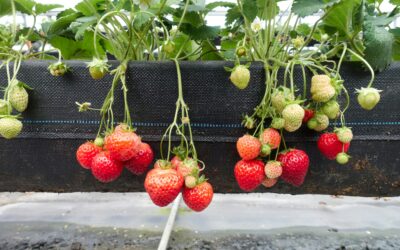
Before the coalition stepped in, strawberry propagation was unpredictable—growers struggled with inconsistent yields and quality.
Hernandez’s team ran a CEA-driven propagation trial, proving that greenhouse propagation could significantly improve plant quality and scalability.
🚀 The result?
✅ A small $50,000 industry-funded experiment turned into a $6 million federally funded research project.
✅ Proof that applied research + industry backing = real change.
Aerospace Engineers Are Redesigning Greenhouse Airflow
One of the coalition’s most unexpected collaborations? Using aerospace engineering to optimize greenhouse climate control. James Braun, assistant professor of mechanical and aerospace engineering at NC State, collaborated with the coalition to better understand the development of climatic patterns within greenhouses.
Why? Because air movement in greenhouses is a physics problem—the same kind that aerospace engineers have been solving for decades.
💡 The goal: Apply computational fluid dynamics (CFD)—the same technology used to design rockets—to optimize airflow in greenhouses.
✅ More uniform CO₂ distribution = Better photosynthesis
✅ Optimized temperature regulation = Lower energy costs
✅ Reduced humidity pockets = Less disease pressure
“We’re using aerospace expertise to understand how air and gas move through different control environments,” says Hernandez.
Even more impressive? Industry members voted to fund this project directly.
💡 High-tech, high-impact, real results.
NC State’s Research Infrastructure: A Competitive Advantage
NC State has some of the best CEA research facilities in the country.
🔹 The Phytotron Building – One of only two such facilities in the U.S., packed with growth chambers for precision climate control research.
🔹 Plant Sciences Initiative Greenhouses – Rooftop, fully air-conditioned research spaces for rapid prototyping.
🔹 Advanced Growth Chambers – Four of only eight in the world, capable of real-time photosynthesis and respiration monitoring.
🔹 Horticultural Department Greenhouses – Commercial-grade research spaces bridging academia and industry.
Why does this matter?
Many universities spend millions just to acquire basic equipment. NC State already has cutting-edge infrastructure, so funding goes directly into research, not overhead.
💡 More dollars spent on solutions, not setups.
Growing the Next Generation of CEA Experts
The coalition isn’t just solving today’s challenges—it’s training the future workforce of controlled environment agriculture.
🔹 Every project funds at least one student, ensuring a pipeline of highly skilled professionals entering the industry.
🔹 One aerospace engineering student now sees greenhouse climate control as more complex than rockets.
🔹 The coalition is expanding internationally, working with a research group in Panama to bring CEA expertise to Latin America.
💡 This is workforce development beyond mere academic research.
Keeping the Industry Ahead: The CEA Coalition Podcast
Most university research groups send out long, dry reports. The CEA Coalition? They built a podcast. Hernandez hosts the series, illuminating the front lines of this research work for commercial applications.
🎧 Designed for busy professionals – Listen while driving, working, or exercising.
🚀 Exclusive early access – Members get research insights six months before the public.
📊 Deep-dive content – Not fluff—detailed breakdowns of data, research, and applications.
💬 “Our goal was to deliver research updates without making it feel like extra work,” says Hernandez.
💡 Information that keeps industry players ahead—without slowing them down.
Final Takeaway: The CEA Coalition Is Changing the Game
What NC State’s CEA Coalition is doing is setting a new standard for how agricultural research should work.
✔ No more silos. Multi-disciplinary teams solve problems faster.
✔ Industry-first research. No wasted effort. No irrelevant studies.
✔ Speed & commercialization. Discovery → Application without the lag.
✔ Leveraging world-class facilities. Funding goes to solutions, not infrastructure.
✔ Training the workforce of tomorrow. The next leaders in CEA are learning here.
The question isn’t whether greenhouse growing is changing—it’s whether you’re ready to change with it. NC State’s CEA Coalition is paving the way. The only question is: Are you following their lead?
Want to Get Involved?
🌱 Join the Coalition – Industry partners can sign up now.
🎧 Listen to the Podcast – Early access for members, then public release.
📊 Partner with Experts – Work with top-tier scientists, engineers, and CEA specialists to drive real innovation.
💡 The future of greenhouse growing isn’t waiting—and neither should you.