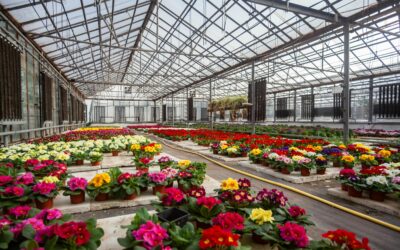
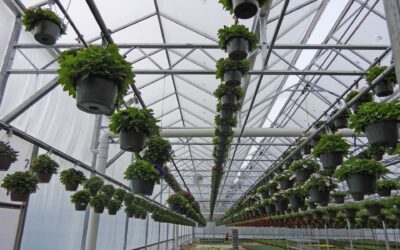
Walk into a commercial production facility and then into a university research greenhouse, and you’ll notice the spaces feel fundamentally different. At the university greenhouse, aisles are wider. The bench layouts follow different patterns. Access points seem generous, where commercial spaces feel tight.
These aren’t just stylistic choices. According to Sylvia Courtney, VP of Design at LLK, the type of greenhouse operation you’re running should fundamentally change how you approach layout, safety, and space allocation.
Referring to the bench-to-aisle space ratio, Courtney explained: “It’s higher for commercial production, it’s lower for institutional production.”
Understanding why this difference exists — and what it means for your facility — can save you from designing a space that works against your operational needs.
The Driving Force: Different Missions, Different Requirements
Commercial operations have a mandate: maximize revenue per square foot. Every inch of aisle space is space that doesn’t grow plants, doesn’t generate income, and costs the same to heat and cool as a productive bench area.
Institutional facilities (like universities, research centers, and botanical gardens) operate under different constraints. Safety requirements are often more stringent. Multiple users need access to the same spaces. Educational functions require accommodation for students and visitors.
These differences translate into design requirements that affect daily operations.
Safety Requirements Drive Institutional Layouts
One of Courtney’s institutional clients demonstrates how safety protocols directly shape greenhouse layout:
“We have to factor in overhead access during layout planning. Everything must be reachable safely, which means we need to accommodate a lift.”
This single requirement — access for equipment — cascades through the entire design.
“I had one project that we worked on where the percentage of bench space to aisle space was lower than desirable because we had to have an aisle wide enough to get a lift in between the benches,” Courtney recalled. “So sometimes [how you lay the space out] depends on the client’s safety requirements.”
For a commercial grower focused on maximizing production, this feels like wasted space. For an institutional client with strict safety protocols, it’s non-negotiable.
When Students Become Design Parameters
Institutional greenhouses face another constraint that commercial operations never consider: multiple people need to occupy and move through tight spaces simultaneously.
Courtney describes an extreme example: “I had one project… that sacrificed bench space to be able to have two students stand in the aisle and pass each other in the aisle in this little tiny compartment.”
This isn’t typical, she noted, but it demonstrates how educational use cases create requirements that purely production-focused facilities don’t face.
In commercial operations, workflow is more controlled. The same paths are used repeatedly by experienced staff who understand the space. In institutional settings, you’re accommodating visitors, students at various skill levels, and researchers who may only occasionally work in that specific area.
The Commercial Push for Efficiency
Commercial operations work under different pressures. Courtney described a typical setup: “I have a commercial customer that we have a 30-foot wide growing area, and we have a two-foot aisle down the center that works well for them.”
That two-foot aisle would be impossibly narrow for an institutional facility with lift requirements or student access needs. But for experienced commercial growers running efficient workflows, it’s functional.
There can be a trade-off, however. “It can sometimes get challenging if we need to get in there to do any maintenance in that narrow space.”
Typically, production gains justify the inconvenience. “That just means it maybe costs them a little more labor because they’re going to have to move things to get in there to do maintenance.”
The concerning part comes when deferred maintenance enters the equation: “Or does it mean that they don’t perform the maintenance because it’s challenging or time-consuming to get to it? And then does that, in the end, result in costing more to fix something because they didn’t do maintenance on a regular basis?”
Commercial operations will calculate this risk based on their specific economic model, and it’s one that institutional facilities generally can’t afford to make.
Why You Can’t Just Copy Another Facility’s Layout
One fundamental mistake Courtney often sees is operators looking at successful facilities in a different category and assuming the same approach will work for them.
A commercial grower visits a university greenhouse and thinks the aisles are wastefully wide. A research facility manager tours a commercial operation and wonders how anyone safely maintains equipment with such tight access.
Both are right within their own context. Both are wrong if they try to apply the other’s logic to their situation.
The bench-to-aisle ratio that maximizes ROI for a commercial poinsettia operation will fail safety inspections at a university. The generous access pathways that serve institutional needs will eat into profit margins for a commercial production.
Equipment and Safety Standards
Beyond just aisle width, the equipment requirements between greenhouse types differ substantially. Commercial operations use carts, rolling benches, and efficient material handling systems designed for repetitive workflows.
Institutional facilities need accommodation for lifts, multiple users, and sometimes specialized research equipment. Safety standards often come from different regulatory frameworks entirely.
“During cannabis times, there were minimum aisle requirements for safety exits in case of a fire or other emergency. They would take [these measurements] to their HSE people, which stands for health, safety, and environment. They review it, and they say, from an ergonomic view, they sometimes would reject things and say, “Well, we need this.”
This review process — common in institutional settings and highly regulated industries — simply doesn’t exist for many commercial operations, which follow different codes and standards.
Getting Your Category Right
Before you finalize any layout decision, you need clarity on which category you’re truly operating in. The answer isn’t always obvious.
A small commercial grower supplying local markets might need wider aisles for cart access than a large wholesale operation. A university with minimal student access might function more like a research facility than a teaching greenhouse.
The key questions to ask:
- What safety regulations govern your operation?
- How many different people need to access the space, and what’s their experience level?
- What equipment needs to move through aisles, and what are its dimensions?
- Are you optimizing purely for production efficiency, or do other functions matter?
Layout Comes Down to Functionality
“They always want to look at what’s the percentage of growing space to the percentage of aisle space,” Courtney said. But that percentage isn’t just a number to maximize or minimize; it’s a reflection of what your facility needs to do.
Commercial and institutional operations face genuinely different requirements. Designing your space means understanding which category you’re in and accepting the constraints that come with it, not trying to force a layout that works beautifully somewhere else but fails in your specific context.
Sylvia Courtney is VP of Design at LLK, where she helps operators create facilities tailored to their specific operational category and requirements.